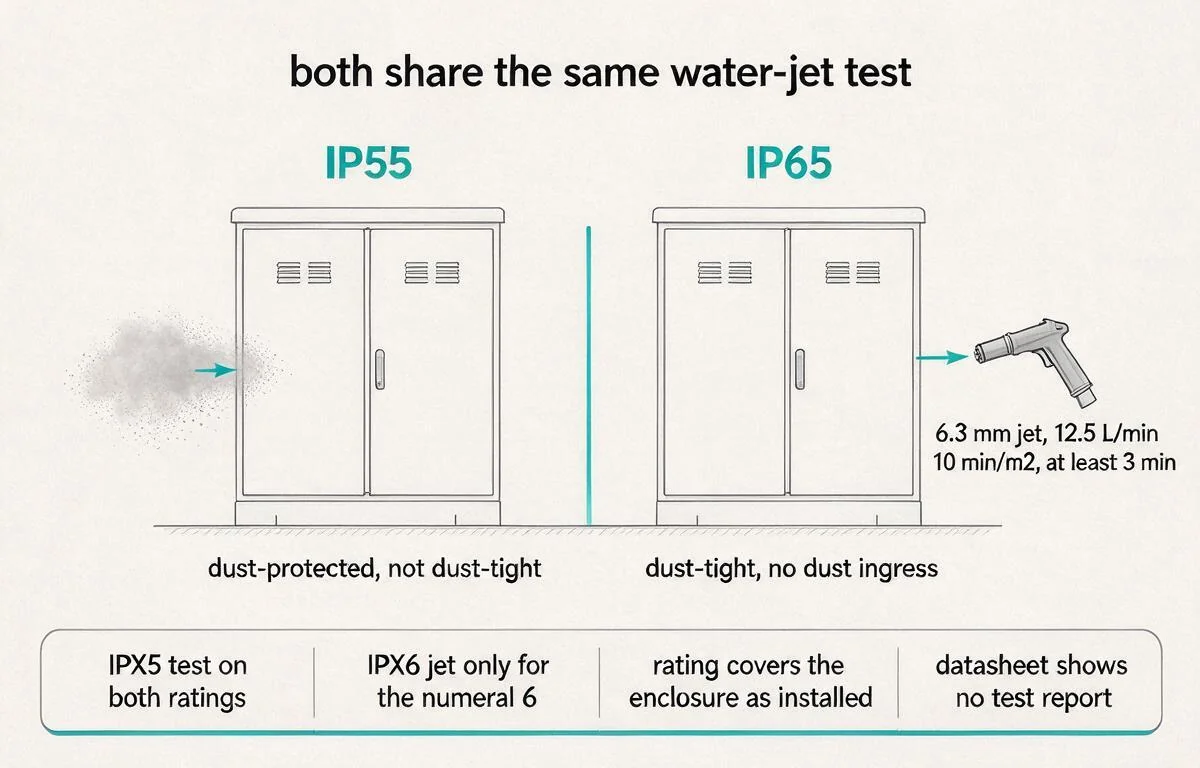
IP55 and IP65 differ in one digit: the first numeral. A 5 in that position means dust-protected, where limited dust may enter but must not interfere with operation or safety; a 6 means dust-tight, with no dust ingress. The second numeral, the water test, is the same 5 for both ratings. That is why our pages can list IP65 for the Outdoor Integrated Communication Cabinet, IP55 for the Outdoor Integrated Cabinet, and "IP55 or higher" for the OLT Equipment Cabinet and the MINI Cabinet without any of them being wrong. Each statement describes a different tested enclosure.
What the two digits actually cover
The code classifies protection against access to hazardous parts, ingress of solid foreign objects and harmful ingress of water. Its scope stops there. GB/T 4208-2017, the identical Chinese adoption of IEC 60529:2013, hands mechanical damage, rust, corrosion, mould, insects, solar radiation, icing, condensation and explosive gases to separate product standards. An IP65 marking therefore says nothing about whether a cabinet resists salt spray or a decade of ultraviolet on its powder coat.
The water half of the code is graded, and the numerals build on each other: a first numeral of 5 or 6 also satisfies every lower numeral, so IP55 includes the splashing-water test. Neither rating covers being held under water; that is graded separately, from numeral 7 upward, and appears on the Intelligent Buried Cabinet where the installation calls for it.
Four annotations, four different commitments
Read together, the cabinet pages make four distinct statements, and only the first two carry a code and a standard reference.
| Page | What the page states | How to treat it in an order |
|---|---|---|
| Outdoor Integrated Communication Cabinet | All technical indicators comply with GB4208-1993; enclosure protection level IP65 | Take IP65 as the target for that enclosure, subject to the configuration and evidence below |
| Outdoor Integrated Cabinet | All technical indicators comply with GB4208-1993; enclosure protection level IP55; resists sand, rain and sunlight radiation outdoors | Take IP55 as the target; the sand, rain and sunlight sentence is descriptive copy, not a test result |
| OLT Equipment Cabinet; MINI Cabinet | Protection level reaches IP55 or higher; rust-proof, corrosion-resistant, suitable for coastal areas | Convert to one number before quoting. "Or higher" leaves the supplied code open |
| ETC Integrated Intelligent Cabinet; site articles on outdoor integrated cabinets | Main cabinet has "rainproof and dustproof" functions; cabinets "dustproof, sunproof and rainproof" | No code stated for the cabinet body. Do not upgrade it to IP55 or IP65 by assumption |
The last row is where acceptance arguments start. A tender can quote that sentence back as though it were a rating, and the answer is that a description of function is not a test. Where the contract needs a code for the cabinet body, ask for one.
Inside the ETC cabinet, the DC48V waterless air conditioner is listed on a separate line item with an IP55 rating. That number belongs to the air conditioner as a fitted unit. It neither raises nor lowers the level of the cabinet, and a component level never stands in for the enclosure level in a handover document.
The real difference: dust acceptance, not water
Both ratings pass the same water-jet test, run with a 6.3 mm nozzle at 12.5 ± 0.625 L/min from 2.5–3 m for at least three minutes per square metre. Because numeral 5 also covers all lower water numerals, an IP55 cabinet has been through the splashing-water test too. What separates the two ratings sits entirely in the dust chamber.
| Item | Numeral 5 (IP55) | Numeral 6 (IP65) |
|---|---|---|
| Dust requirement | Dust-protected: limited ingress allowed under specified conditions, provided it does not affect operation or safety, with no deposit where it could cause tracking | Dust-tight: no ingress of dust |
| Dust test method | Talc dust chamber, tested with or without vacuum depending on the enclosure's pressure type | Same dust chamber, always with vacuum — the enclosure is treated as a pressure-below-atmosphere type |
| Water requirement | Jets from any direction with no harmful effect | Jets from any direction with no harmful effect |
| Water test | 6.3 mm nozzle, 12.5 ± 0.625 L/min, 2.5–3 m, at least 3 min | Identical test, the same IPX5 jet gasket for gasket |
| Numeral 6 water test, not required here | IPX6 uses a 12.5 mm nozzle at 100 ± 5 L/min, roughly eight times the IPX5 flow. Neither IP55 nor IP65 has to pass it | |
| Acceptance after testing | Water that does get in must stay clear of live parts, cable heads and insulation where it could track; drains must let it out rather than let it collect | The same water limit, plus the stricter dust condition |
The water column records no difference at all, which is why a buyer who reads IP65 as the bigger number should look again. A gasket that holds the IPX5 jet on the IP55 has withstood the identical jet on the IP65; whether it also passes the vacuum dust chamber is the question that decides the code.
Why one cabinet body can carry a different code
A code describes an enclosure as tested, and the standard lets a product standard set a different marking when parts of an enclosure have different levels or when the mounting position changes the result. In an outdoor cabinet, the deciding parts are the ones that were never part of a plain shell: the seal along the whole door perimeter, the hinges and the lock, the cable entry plate, and above all the vents.
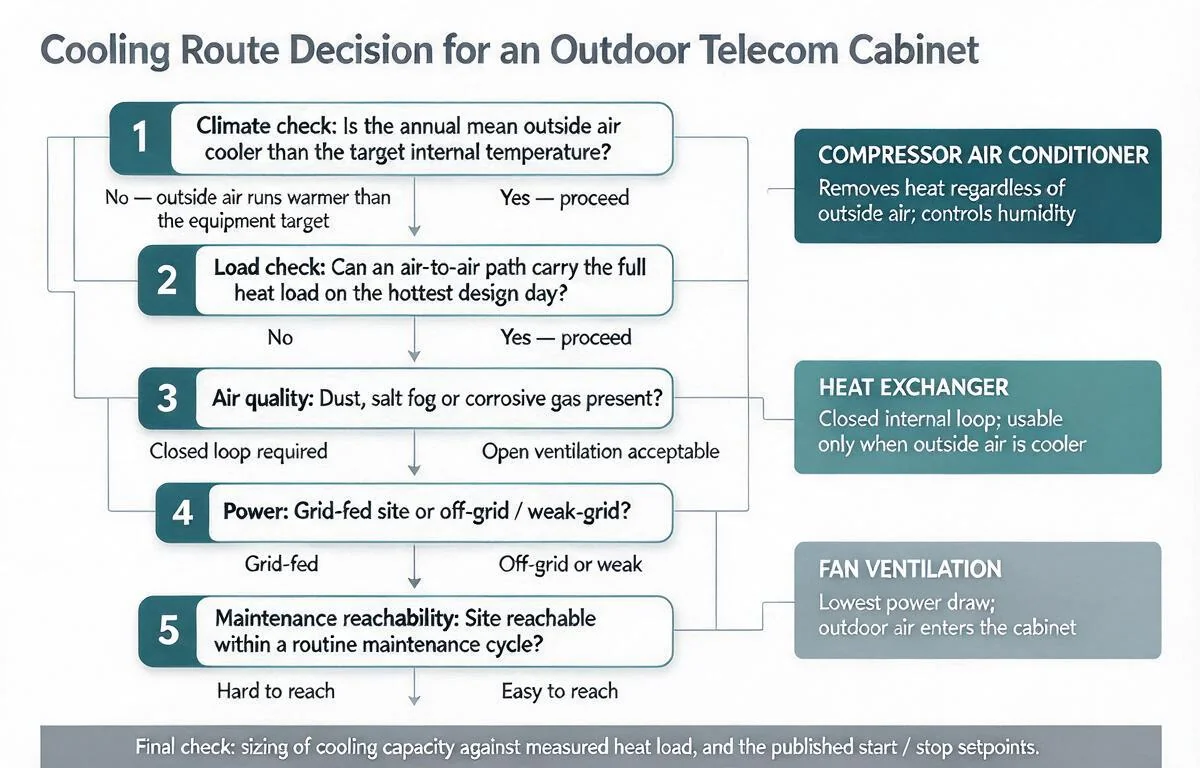
Unpowered cabinets with sheets of metal and no openings are easy to seal compared with ones fitted with a fan, a heat exchanger or a compressor air conditioner. The cooling route is not a detail of the protection argument; it is the protection argument. Our comparison of fan, heat exchanger and air conditioner cooling covers the thermal side of that choice, and the same three routes set the sealing problem here: a fan route that draws outside air through a filter cannot promise dust-tightness, a heat exchanger keeps two air paths apart and depends on its own seals, and a closed air-conditioned cabinet rests the result on the door gasket and the cable entry plate.
This is also where IP65 cabinets lose their claim after delivery. A crew that drills an extra cable hole, fits an antenna feeder through an unsealed gland, or leaves a filter frame misaligned has built a different enclosure from the one tested, and no rating survives that.
What a GB4208-1993 reference does not prove
The standard those pages cite has been withdrawn. On 6 November 2026 the national standards platform listed GB 4208-1993 as obsolete, replaced by GB/T 4208-2008 and then by GB/T 4208-2017, in force since 1 February 2018 and re-confirmed as current in March 2025.
An older citation is not automatically wrong. GB/T 4208-2017 kept the protection levels defined in the 2008 edition and only added a second numeral 9, and its own introduction notes that an enclosure marked under the previous edition will generally suit the same level under this one. What the citation does not give you is evidence. These pages carry no report number, laboratory name or specimen record, so the IP55 and IP65 statements are documented product claims rather than results you can inspect. The table below is where that gap gets closed.
Coastal and high-humidity sites
The OLT Equipment Cabinet and MINI Cabinet pages pair "IP55 or higher" with rust-proof, corrosion-resistant construction for coastal areas. Treat that as two commitments. The code covers dust and water jets; corrosion resistance belongs to the coating and material specification, a different test family. A buyer comparing two coastal offers should ask for both lines with the same discipline: the level and its report, and the coating scheme with the corrosion test it was qualified against.
Condensation is a third matter again. The code's scope excludes moisture from condensation, so a cabinet can hold a valid IP55 or IP65 marking and still collect water inside when a warm humid night meets a cool metal enclosure. That is a ventilation and thermal-design question, not a gasket question.
Putting the rating into the quote and the acceptance
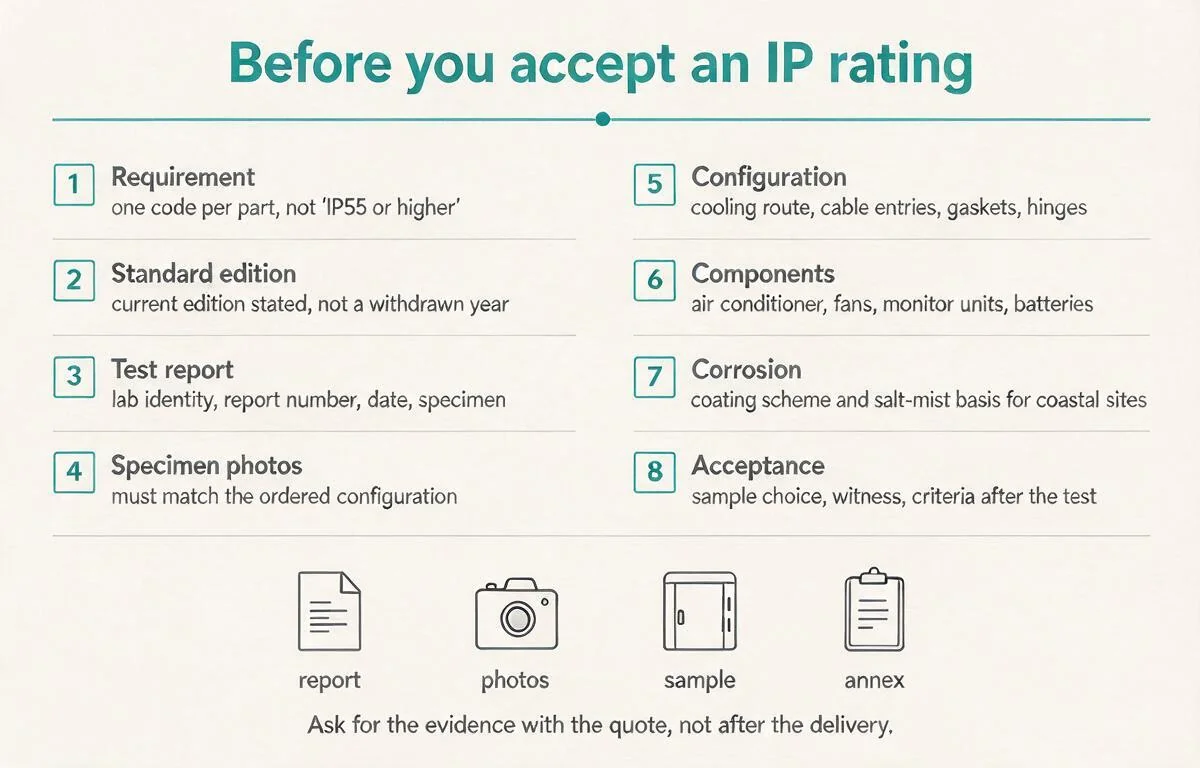
Most of the risk in this category is removed before the contract, by turning a range into a statement and asking for the evidence in the same message.
| Item to fix | What the buyer asks for | Who supplies it | What raises a query |
|---|---|---|---|
| Requirement | One code per part — for example the cabinet body IP55 and the air conditioner IP55, each named separately | Buyer, in the enquiry | "IP55 or higher" or "IP65 grade" with no single value |
| Standard edition | An edition with a year, plus the acceptance criteria applied | Supplier, in the offer | A withdrawn edition presented as the basis of compliance |
| Test report | Laboratory identity, report number, date, and the scope the laboratory is accredited for | Supplier, from the laboratory | No report attached, or a report for a different product |
| Specimen | Photos and the configuration tested: cooling route, vents, cable entries, gaskets, hinges | Supplier, from the test file | The report covers a bare shell while the order includes two air conditioners |
| Components | A component schedule with each fitted unit's own level | Supplier | The cabinet level quoted for a filter fan or an unsealed antenna port |
| Acceptance | Sample selection, witness or photo record, and the pass criteria after the test | Buyer and supplier, agreed in the annex | Acceptance by visual inspection of the door seal alone |
Two smaller points belong in the same annex. The test specimen should be new and clean, installed the way the site will install it, at an ambient temperature of 15 °C to 35 °C with water within 5 K of the specimen; a test run under other conditions should say so. And because numerals 5 and 6 share the dust chamber but differ in acceptance, a frame that fails the numeral-6 condition does not by itself fail numeral 5. A supplier may legitimately offer the IP55 unit in its place provided that unit demonstrates the numeral-5 condition in its own report.
A note to the cabinet, not just about it
Ask for the protection level on the drawing and the report with the quotation. If a page or a tender says IP55 or higher, reply with one value per part; if a page says only dustproof or rainproof, ask for a code before it enters the specification. Those two habits keep the acceptance meeting short.
For a project being specified now, send the site conditions (rain exposure, dust, distance from the coast), the cabinet family and the internal equipment, and the protection level the client wrote down. We will return the code we would supply for each part, the standard edition behind it, and the evidence we can put against it.
——END——