Three cooling routes are on the table for an outdoor telecom cabinet — fan ventilation, an air-to-air heat exchanger, and a compressor air conditioner — and on our Outdoor Integrated Communication Cabinet page all three switch on at the same internal temperature of 35°C. That shared start point is the most misleading number in the specification table. It says nothing about whether the chosen path can hold the equipment at a safe temperature on the worst afternoon of the year. The differences that decide the order sit in the stop points and in what each path does with outside air: the air conditioner stops at 30°C, the fan at 27°C ± 4°C, the heat exchanger at 25°C.
Read the whole row rather than the start column. A 35°C start tells you when the controller asks for help. The stop point and the path itself tell you how much help you got. That is why a heat exchanger described only as "starts at 35°C" can be specified into a site whose outside air never gets cold enough to do useful work.
The thermodynamic floor under all three methods
Fan ventilation and a heat exchanger both move heat from the cabinet air to the outside air without a refrigeration cycle. Their cooling effect falls to zero as the two temperatures converge. Industry practice draws the first practical line here. A heat exchanger suits mild climates and remote sites that are expensive to visit. A compressor air conditioner is the usual choice where internal heat loads are high, outside temperatures are severe, or moisture must be controlled.
A compressor air conditioner works differently. It does not need outside air cooler than the cabinet; it moves heat out through a refrigeration cycle and, in doing so, pulls moisture out at the evaporator. That independence from outside temperature is what you pay for in power draw and in moving parts. It also explains why the air conditioner option on this cabinet runs its internal circulation continuously while its external circulation cycles between 35°C and 30°C.
The published start and stop points, and what the gaps mean
The parameter table lists the three control paths separately. Set side by side, their switching behaviour becomes visible.
| Cooling path | Internal circulation | External circulation start | External circulation stop | Switching band |
|---|---|---|---|---|
| Air conditioner | Operates continuously | 35°C | 30°C | 5 K |
| Fan | Not separately stated | Starts at 35°C | Stops at 27°C ± 4°C | 8 K ± 4 K |
| Heat exchanger | Operates continuously | 35°C | 25°C | 10 K |
The fan row carries a dash in the circulation column because the table only gives that fan its own start and stop points; no internal or external circulation mode is published for it. The band in the last column is the gap between the published start and stop values, not a separately published figure. On the fan row it inherits the ± 4°C tolerance, so the same fan might hold on roughly 4 K longer, or release about 4 K sooner, than the nominal 8 K.
What the 25°C stop point and the 5 K interval actually mean
The two published control points set the operating window on the heat exchanger. External circulation starts when internal temperature reaches 35°C and stops when it falls to 25°C, with internal circulation running continuously. That is a 10 K interval of internal temperature, derived from the published pair rather than a separately published design figure. Governing the stop by internal temperature also means the controller does not need an outdoor reading to end external circulation, and no published source states why 25°C was chosen. Whether a given unit uses this interval for cycling control or links to another cooling component is a matter of its configuration and control wiring, not of the published pair.
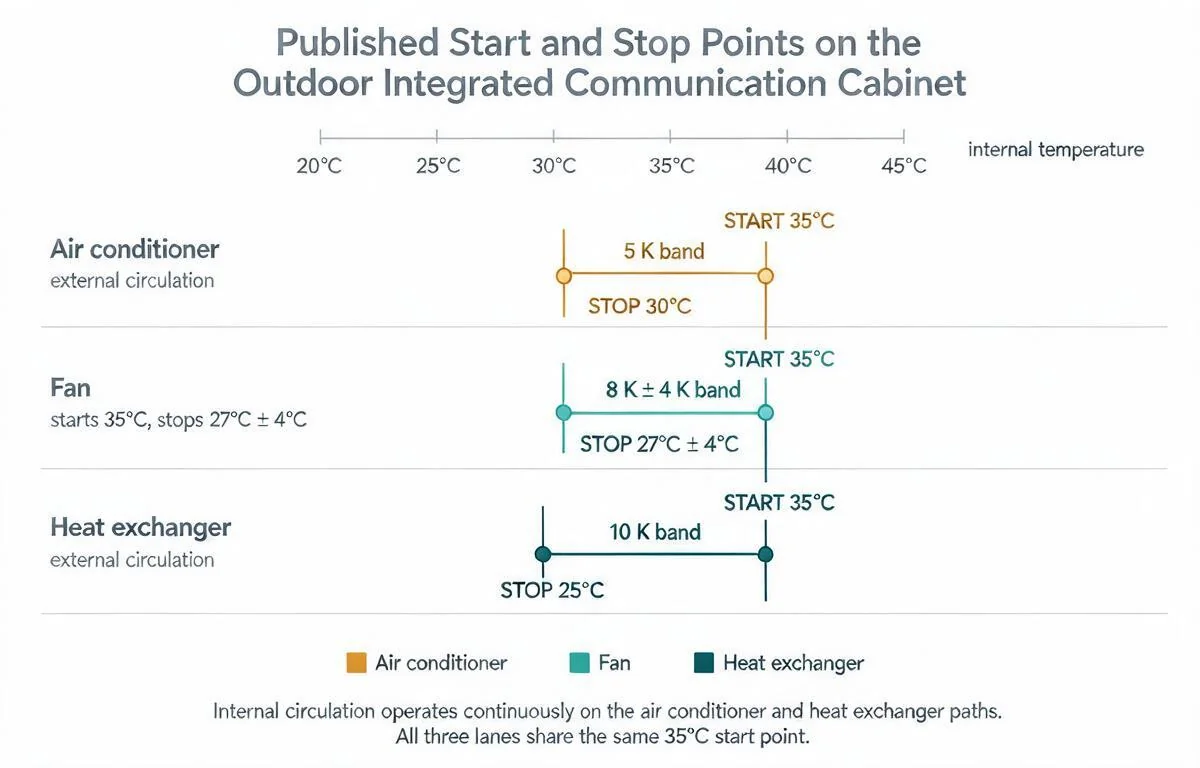
On the air conditioner path the published pair is 35°C to start external circulation and 30°C to stop it, leaving a 5 K interval of internal temperature, and the internal circulation runs continuously alongside it. Set next to the heat exchanger's 10 K interval and the fan's nominal 8 K, the comparison gives the reader the three operating windows in one place. What each interval is used for in service is decided by the unit's configuration and control wiring, which the published table does not describe.
One reading of the fan row deserves care. "Starts at 35°C and stops at 27°C ± 4°C" describes the fan's own control points and nothing else, so a cabinet cooled by fan ventilation alone can legitimately sit above 30°C before anything moves. The cabinet page states an operating temperature range of -20°C to +60°C for this model. That is an ambient capability figure. It is not a promise that internal air stays below 35°C in every climate with fan cooling.
Five gates: climate, heat load, air quality, power and access
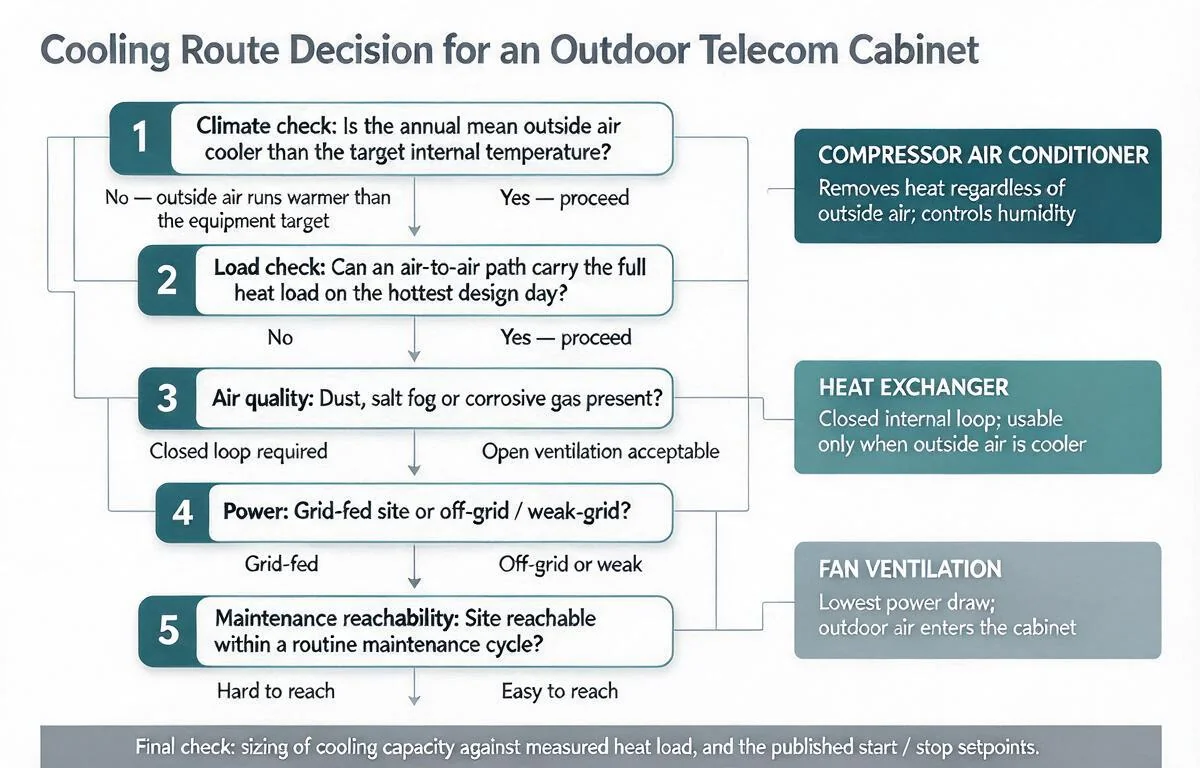
Five site conditions should drive the choice, not catalogue preferences: climate, heat load and compartment, air quality, power, and maintenance access. Check them in that order, because an earlier gate can remove a route before the later ones matter.
1. Climate: can outside air do the job on the hottest design day?
Start with the site's design outdoor temperature rather than its annual average. If the hottest days leave outside air several kelvin below the internal target, a heat exchanger or fan has real capacity. Where summer air regularly runs at or above that target, those paths stop contributing at exactly the moment the cabinet needs them. The load then falls back to the compressor path, or it is not removed at all.
Humidity belongs in the same step, and it splits the two air-to-air routes. Fan ventilation admits outside air directly, so the same air that carries the heat load also carries its moisture into the equipment space. On a coastal or monsoon site with a dew point close to the internal temperature, that means a filtration and condensation question at the air intake as well as a cooling question. A closed-loop heat exchanger keeps the equipment-side air separate from the outside air during normal operation, so outside moisture does not simply pass through it. It still cannot provide active dehumidification; only the compressor path removes moisture at the evaporator. A site that needs positive humidity control is therefore an air conditioner site however pleasant its average temperature looks.
2. Load: how much heat has to leave, and from which compartment?
The air-to-air paths have a practical ceiling set by airflow and exchanger area, so the equipment heat load is the second filter. Dense radio units, switches and power conversion can exceed what a passive exchanger removes on a warm day. Our cabinet page does not publish a cooling capacity for the air conditioner option, so capacity has to be sized against the heat load you actually expect rather than assumed from cabinet size.
The two compartments also need separate treatment. The equipment compartment uses ventilation for heat dissipation, with a heat exchanger selectable as the dissipation equipment. The battery compartment in the described integrated cabinet is separated from the equipment space by a partition and uses semiconductor refrigeration, an option not available on roadside-type cabinets. A load figure for the equipment racks should not be applied to the battery compartment, and vice versa.
3. Air quality: dust, salt fog and corrosive gas
A heat exchanger keeps internal air on a closed loop and uses outside air only as a secondary medium. Dust, salt particles and corrosive gas stay out of the equipment space while heat still leaves. That is the strongest argument for the closed path on coastal and industrial sites. Fan ventilation admits outside air directly and carries the same particles into the cabinet, so the filter regime becomes an operational commitment rather than an accessory.
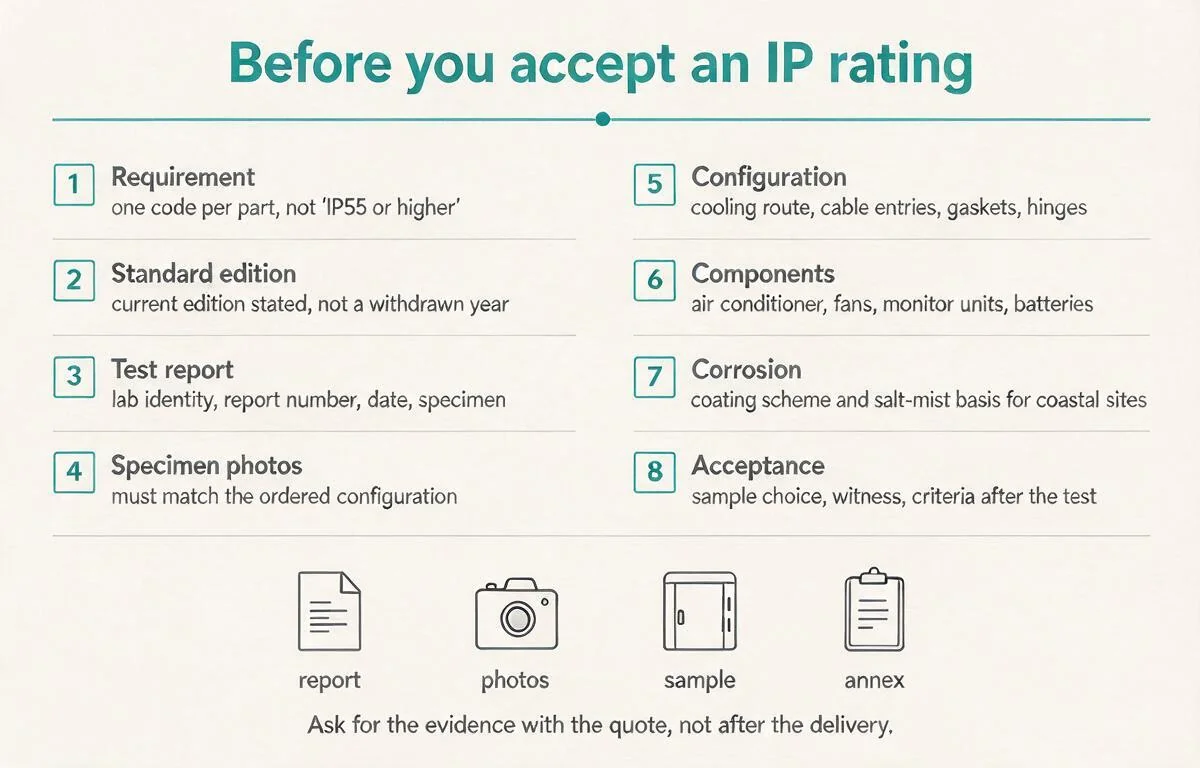
The cabinet page states an enclosure protection level of IP65 under GB 4208-1993. In the IEC ingress protection coding, the first numeral covers solids on a scale from 0 to 6 and the second covers liquids from 0 to 9, with the test conditions held in IEC 60529. The IP figure is the enclosure's baseline, not evidence about the air path. A ventilation opening and its filter are a separate design decision, and an open loop reaches the internal equipment by routes the enclosure rating does not describe.
4. Power and maintenance access
A compressor is the highest-power option in the cabinet. On an off-grid or weak-grid site, its draw competes with the radio load and the battery budget. An air-to-air exchanger has no compressor to run, which is why industry practice treats it as the conventional choice for solar-powered and unmanned sites where the climate cooperates. The trade is that its capacity depends on weather the site cannot control.
Maintenance reachability then decides how much complexity you can accept. A compressor brings refrigerant, a compressor, filters and a condensate path that need periodic attention; a heat exchanger brings exchanger surfaces and two fan sets; a fan brings filters and blades. Where a technician can reach the site on a routine round, the air conditioner's upkeep is manageable and its performance is worth it. Where the site is visited once a season at best, fewer moving parts and no refrigerant circuit carry more weight than the extra cooling margin.
The integrated cabinet family also carries power and environmental monitoring that can upload alarms for power failure, power fault, access control, temperature, humidity, smoke, water immersion and battery voltage. Test the route you choose against that alarm stream. A site that cannot be reached easily needs the temperature alarm to arrive before the equipment does, which argues for sizing margin about as strongly as the climate does.
The emergency fresh-air path on the intelligent cabinet
The integrated intelligent cabinet adds a path that is deliberately not part of normal operation. It uses a circular air duct driven by the air conditioner's indoor fan, which is connected to the UPS supply, so air distribution continues under normal conditions with supply layered rack by rack. Under abnormal conditions, when accumulated heat exceeds 35°C, air vents open automatically to introduce outside fresh air for heat exchange.
In its high-availability description the cabinet also includes an emergency measure for an air conditioner fault. An emergency air supply module at the front top blows air downward while an emergency exhaust module at the rear top discharges hot air outward. The power and environmental monitoring system reports the equipment status. The published descriptions do not say whether these modules and the 35°C vent opening are one system or two, so treat them as features to confirm against the specific cabinet configuration rather than as a guaranteed chain. Emergency ventilation is listed among the subsystems the integrated cabinet brings together, alongside UPS supply, distribution, refrigeration and monitoring.
Treat all of this as emergency protection. The 35°C trigger is a threshold for an abnormal condition, not the normal operating setpoint of the fresh-air route, and that route cannot substitute for a correctly sized cooling method. What it buys is time between a failure and a site visit, which is the part of the risk that a route choice alone cannot remove.
Selecting in practice
A site that clears all five gates can use the cheapest path that fits. The design outdoor temperature needs to stay below the internal target for most of the cooling season. Airflow and exchanger area must carry the load. Dust and salt have to be controlled. Someone has to service the filters and the moving parts. Given all of that, plus a grid feed or power to spare, fan ventilation or a heat exchanger is the sensible specification.
The air conditioner earns its place as soon as one gate fails hard. That could be outside air hotter than the target during the load peak, a heat load beyond what an air-to-air path can move, an air stream that cannot be cleaned to the equipment's tolerance, or a need to hold humidity down. A remote site is not automatically an air conditioner site, and a hot site is not automatically a heat exchanger site. The gates decide, not the label on the region.
What to send with a specification request
We can confirm a configuration and its control points against your site rather than against a generic case when the request carries the conditions the gates above actually test:
- Design outdoor dry-bulb temperature and how long it lasts, plus dew point or relative humidity during the humid season.
- Expected internal heat load in watts, split between the equipment compartment and the battery compartment.
- Cabinet size and likely load count if the site will expand.
- Power source and available budget: grid, generator, solar, or a mix, with the daily energy the cooling path may use.
- Dust, salt-fog and corrosive-gas exposure, plus any filter maintenance interval you can sustain.
- Maintenance route and response time, including whether the site is unmanned.
- Whether the intelligent cabinet emergency fresh-air path or the standard cabinet configuration is under consideration.
Send those to us through the contact page and a cooling route, its published start and stop points, and the alarm set that matters for your site can be fixed in one reply. If you are still comparing cabinet types rather than cooling paths, the outdoor integrated cabinet range puts the compartment layouts side by side. Our notes on the characteristics and values of integrated intelligent cabinets and their advantages describe the emergency ventilation arrangement.
——END——